The PyCon AU 2026 CFP closed a little over 12 hours ago. In this post, I’m going behind the scenes with our program review committee to share a little more publicly how we select talks for the conference.
In order to establish a diverse and engaging conference program representative of the Python community in Australia, we do a lot of pre-work to get the word out about CFP. Workshops, meetups, social media, emails, and good old fashioned cold outreach. We cast a wide net, and invite speakers from all walks of life to submit their ideas for the conference. That is, “as long as the talks are relevant to people who use Python”.
This year we had a phenomenal response. One of the strongest CFP submission rates in many many years. Wow. I have resisted the temptation to add a third line labeled “Program Chair stress levels”. I’ll leave it to you to guess where it fits.
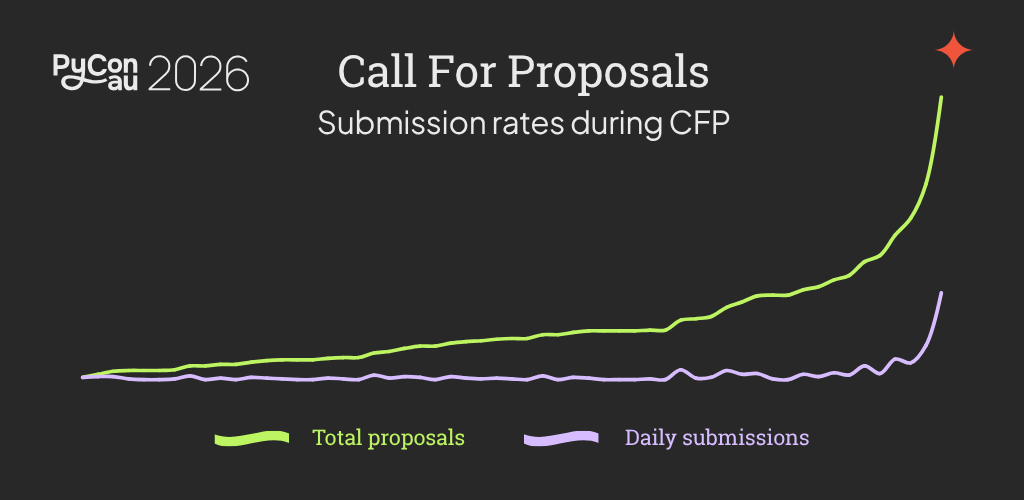
All of this is designed to give the program review committee a large set of talks to be considered for the conference.
This year we’ve invited over 50 people from a vast array of technical and industry backgrounds to give us feedback on the talks submitted during CFP.
This includes reviewers who:
The program review committee changes most years, as some people enjoy a year off allowing others to bring in fresh perspectives. It’s been heartening to see Python communities around Australia growing once again in recent years and it’s important to the conference that these communities are represented at the conference too. We also assess the experience and bias of the volunteer team organising the conference and look to address gaps in our own backgrounds and knowledge.
While our reviewers are assembling, reading the guidelines and getting access to various systems, the conference reviews every session submitted to ensure the title, abstract, description and notes are anonymised. This is to ensure that all sessions have an equal opportunity to be selected for the conference. You can read more about the CFP anonymisation guidelines in depth.
Each reviewer is given the option to score a talk between -2 and +2. Reviewers can also abstain if they feel like they are not in a position to review the talk (for example, in a different area from their expertise), or if they are unable to assess the proposal given their biases or conflicts of interest. We have fairly comprehensive documentation to support our reviewers in navigating these scenarios.
In addition to scores, we ask our reviewers to provide comments. Comments are typically not just “I like this proposal”, they’re there to give useful insight into how the talk could fit well into the conference program. A good example is “This talk is a thoughtful addition to a topical discussion in <the technical field> and the abstract/description outline gives me confidence the speaker can do the topic justice”.
Importantly, we ask reviewers to consider how a talk might be successful, not to use the review process to be critical for critical sake.
The first round of reviews takes about two weeks. We ask reviewers to consider the talk on its merits, not factoring in who has submitted the proposal. Is the talk descriptive of the topic? Is the abstract clear, and does the description provide enough detail for attendees. Are the notes relevant and provide useful context to the reviewers?
In the second round of reviews, we re-visit the previous comments and scores with the additional context of who the speaker is. In this review, we are not assessing the speaker bio by itself. Instead, we’re looking to understand the pairing between the talk proposed, and the presenter proposing it. For example, we LOVE seeing proposals from junior engineers sharing their experience and learning journey and we do not expect those presenters to ‘fake’ being more senior in their career than they are. Their story is welcome at PyCon AU just as much as others. Similarly, we’re looking for a range of technical and professional backgrounds.
Building the program for PyCon AU is a particularly difficult task - primarily because we received so many spectacular talk proposals and we have a finite number of slots on the schedule we can offer up.
Drawing on the comments and feedback from the review process, the program is slowly pulled together over a weekend of long meetings . We usually start with the specialist tracks and then move onto the main conference program. All talks not accepted to a track are still considered equally for the main conference.
You might hear this process referred to as the ‘Thunderdome’. This year we’re planning on holding multiple smaller thunderdomes. We call it this because the program chair’s sanity enters and a program leaves afterwards. It takes many, many, many hours of discussion to shape the conference program. It may shock you that the program review committee is full of people with suggestions and strong ideas about how the conference program should be formed. 🙂
There are lots of reasons proposed talks don’t quite make the schedule. Unfortunately, sometimes even very highly reviewed talks have to be declined simply because we have a LOT of proposals on the topic. I appreciated this post on Bluesky from Maggie Fero recently about navigating rejection from conferences and I recommend everyone read their thread of thoughts.
Ultimately, the program review process is a mammoth collective effort from people around Australia (and this year, New Zealand) who care greatly about having a spectacular conference for everyone to enjoy in August.
The whole review process takes us about 4-5 weeks; sometimes longer if the CFP has a high volume of submissions (like it did this year). We appreciate that speakers want to hear back soon (and be working on their talks). We also want to ensure our reviewers can give appropriate consideration to each and every proposed idea.
This year, we’re aiming to get in touch with speakers in early May, with a view to have contacted all speakers by mid-May. Acceptance emails will go out first, and likely ask speakers to confirm (or keep us in the loop about constraints) within a few days of that email. It’s natural that some speakers have to decline the invitation, so we work through the program committee’s recommended talks until we’ve filled every slot in the schedule.
Once finalised, then comes the sad task of letting unsuccessful proposals know their talk hasn’t been accepted to the conference. Unfortunately we do decline the majority of proposals to PyCon AU but we’re committed to communicating back to every proposal - we don’t ghost the people who’ve taken the time to submit to the conference.
The schedule is a multi-dimensional game of Tetris, balancing a mix of tracks, themes and speaker schedules. We look to build a balanced program across the three days of talks. It is typically drafted a few days after acceptances are finalised but it’s always possible for changes to be made between May and when the conference starts in August.
If you’re reading this post having just submitted a proposal to CFP for the first time: thank you! If you’re a regular submitter, or you’ve spoken at PyCon AU before. Thank you too!
Now, if you’ll excuse the committee, they have a few hundred proposals to read through!

