Earlier today we sold out of our final ‘quota’ of blind bird tickets. Since ticket prices will now go up to retail price, this post is to share as transparently as I can, how we think about our prices and discounts.
A surprisingly large amount of background work went into our decision to… not change anything from 2025.
Ticket prices in 2026 are the same as 2025, which are cheaper than 2024. All of this is in the face of rising supplier costs and economic inflation. A lot of work goes into making this possible.
Our ticket categories are varied (arguably too varied!). They present complexity during the buying process, and an e-commerce expert would likely have a field day analysing our marketing of these tickets.
Given that we have different ticket prices to address affordability, discounts are typically offered to incentivise buying behaviour rather than to address affordability:
In the original PyCon AU 2026 budget from mid 2025, we had planned to do two releases of early bird tickets, with prices jumping up to the list price (RRP) in between. We quickly realised this made no sense and actually penalised attendees who registered in between those two discount releases. So we re-jigged the plan to have a gradual progression from early bird, to blind bird and eventually up to RRP once sold out. This averaged the same discount overall, but gave us clearer milestones for marketing and still encouraged early registration without incentivising people to hold off buying in the hope of a later discount.
PyCon AU is a community conference. It is run by volunteers, and its primary objective is to further the community and industry around Python in Australia. Keeping the conference affordable is one of the many facets of making a conference like ours accessible to a broad community base, and keeping ticket prices as low as possible is a conscious act of inclusion.
The ability to attend a conference like PyCon AU is also a privilege not available to many. This is something we think a lot about behind closed doors. It’s not something we can solve exclusively behind those doors - but it has been the topic of many hours of discussion.
This segues nicely into some other programs we run that are proactive and intentional acts of inclusion. This approach to inclusion isn’t just intent and good will, it’s structural within our budget and dedicated line items that cost us money.
At a fundamental level, having any price of admission at a conference requiring travel, will result in some people being unable to afford to participate. In an ideal world, corporate Australia would fund us with no strings attached. In reality, we have invoices with deadlines, sponsors with expectations, and as volunteers we have lives that need living beyond the labour of running this conference for free.
So… we must balance our community values of access, equity and inclusion, with the pragmatism of running a large tech event with an all-volunteer team
Yes, to be transparent, sometimes a decision gets made that is imperfect for access and inclusion, because we’ve optimised around things like reducing volunteer burnout. It’s not that we can’t be bothered, it’s that people won’t come back if we ask too much of them.
Remembering also that ticket prices are one aspect of affordability. Running the conference in an expensive city means things like meals and accommodation are more expensive which negates the impact of a cheap ticket.
For example, for a Brisbane local to buy a $550 enthusiast ticket is a very different economic consideration when compared with the costs faced by a Melbourne-based attendee who’s looking at the total cost of their third PyCon AU potentially tripling. This increases even more for our friends travelling from Perth or from regional Australia. Airfares, accommodation, transit, incidentals, meals etc. are all component costs to the overall financial commitment to join us at the conference.
PyCon AU historically changes cities every two years… so while we’re well aware that total cost of attendance is a consideration, some change over time is somewhat to be expected.
While less obvious, we also consider the costs of taking leave to self-fund attendance, childcare and family impacts, and other non-monetary ‘costs’ of making it to a five-day tech event. The concept of running a nine-day one-track conference is an extreme example to illustrate how much this is all interconnected.
We are also mindful of the post-conference crash when you get home. That hits hard every year - and I budget my time to have minimal social or professional engagements for the week or two after every PyCon AU!
Our wonderful lil’ community doesn’t exist in a bubble. Attendees and sponsors have choices of other events throughout the year. Various industries have camps, symposiums and summits and ‘days’. Sponsors weigh up audience sizes, locations, technical and demographic factors. Most organisations have a finite spend on professional development and need to decide between technical conferences like PyCon AU vs other ways to spend learning and development budget for employees.
The following chart is an incomplete comparison of ticket prices across several technical events that run on the east coast of Australia. I’ve intentionally obscured the X-axis, which named the events, because this is not intended to be a one-to-one comparison with any specific conference, nor do we want to start an argument between conferences. This includes a mix of events marketed as ‘community’ and ‘not-for-profit’ as well as conferences explicitly run by for-profit companies with salaried staff and a professional delegate focus.
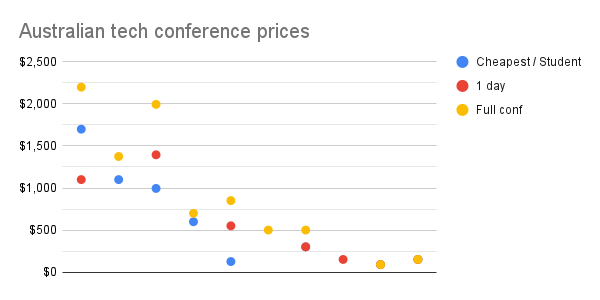
What this aims to show is that PyCon AU sits squarely in the middle of affordability. Our cheapest student tickets are on-par with some of the most-affordable tech events across the industry. All while having a well respected program of technical talks from skilled presenters, that professionals can arguably consider to be a bargain compared with other conferences.
When building our financial model for PyCon AU 2026, we calculated the ‘average breakeven ticket price’. We use this to inform decision making, but not to blindly define our ticket prices via a formula.
The average breakeven price is a somewhat complex calculation. It factors in:
There’s a LOT of variability in this model. We built a few models too since different venues had differently structured costs across quotes. Overall, it helps inform our pricing floor must be for any given attendance scenario.
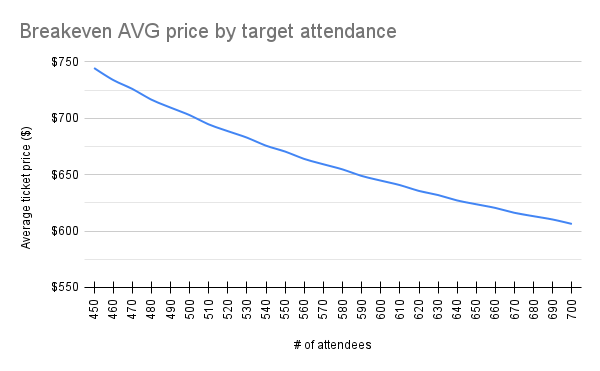
All this is to say, and show, a relatively straight forward concept: if more people attend a PyCon AU, we can average the fixed costs of running the conference over a greater number of attendees and thus, maybe, one day, reduce the overall ticket price again.
At least, for 2026, that’s manifesting in two goals and commitments in our budget:
Note: Growth for growth sake is not a useful goal for PyCon AU. Past a certain point, growth means we exceed crowds that a volunteer team of our current shape and size can reasonably manage. That’s not to say that big events are unmanageable - lots of huge volunteer teams run bigger events - it’s just to say for our shape and size, we’d have to change a lot behind the scenes.
However, if we aim to grow from 2024 and 2025 figures, then it gets us one step closer to a lofty goal of maybe, just maybe, having cheaper ticket prices! (Or if not ticket prices, more benefits, financial assistance programs and generally less anxiety on organisers about the break-even position of the conference).
So all this is to say… please register! Early and often!
Registering early goes a LONG way to helping ensure that we can continue to make conscious, equitable decisions and make proactive acts of inclusion beyond the bottom line of the conference!

